


Customer Data Platform: figures and market trends
9min • Last updated on Sep 14, 2026


Olivier Renard
Content & SEO Manager
Since David Raab introduced the term in 2013, the Customer Data Platform market has expanded beyond tools for collecting customer data. CDPs now bring together profile management, analytics and activation capabilities to help businesses turn fragmented information into coordinated marketing actions.
For businesses exploring CDP solutions, market figures provide useful context. However, estimates differ according to the products, services and vendors included. Understanding those differences matters as much as knowing the headline growth rate.
Key takeaways
A market worth several billion dollars: MarketsandMarkets estimates USD 7.34 billion in 2026, while Mordor Intelligence estimates USD 4.58 billion. These are separate estimates, not interchangeable measurements.
A practical business role: CDPs unify customer data and help marketing teams build audiences, personalise experiences and coordinate engagement across channels.
Evolving architectures: traditional, composable and hybrid platforms offer different ways to manage customer profiles and connect existing systems.
Changing requirements: identity resolution, governance, AI and the time needed to activate data are important dimensions of a CDP project.
Customer Data Platform: definition and concept
A Customer Data Platform collects, organises and makes customer data available for use by other systems. It brings together information from sources such as websites, mobile apps, email platforms, CRM systems and in-store transactions to create unified customer profiles.
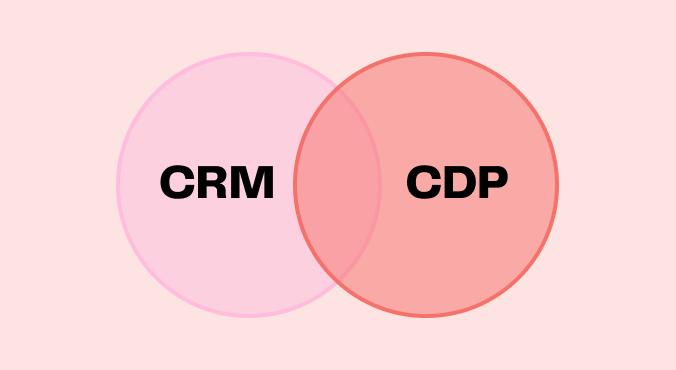
A CRM primarily supports the management of customer relationships and interactions. A CDP connects that CRM data with behavioural and transactional data from other sources. The two platforms can work together: sales and service teams contribute relationship information, while marketing teams use the combined customer view for segmentation and activation.
Identity resolution is a key part of that process. One customer may appear under an email address in a marketing platform, a loyalty number in a store and an account identifier in a CRM. Matching those records helps the business recognise the same customer across channels. Matching rules also need safeguards: a shared address or device does not necessarily identify one person.
Packaged, or traditional, CDPs bring data collection, profile storage and activation into a dedicated platform. A composable CDP builds on an existing data warehouse and connects the capabilities the business needs. Hybrid platforms combine elements of these approaches. The boundary between categories is not fixed, so assess how each platform handles your actual data.
Warehouse-based architectures can reduce the need for a separate customer database. They do not mean that no data ever moves: an email platform or advertising destination may still receive audience identifiers and selected attributes. Implementation time depends on data readiness, integration work and the use cases being delivered.
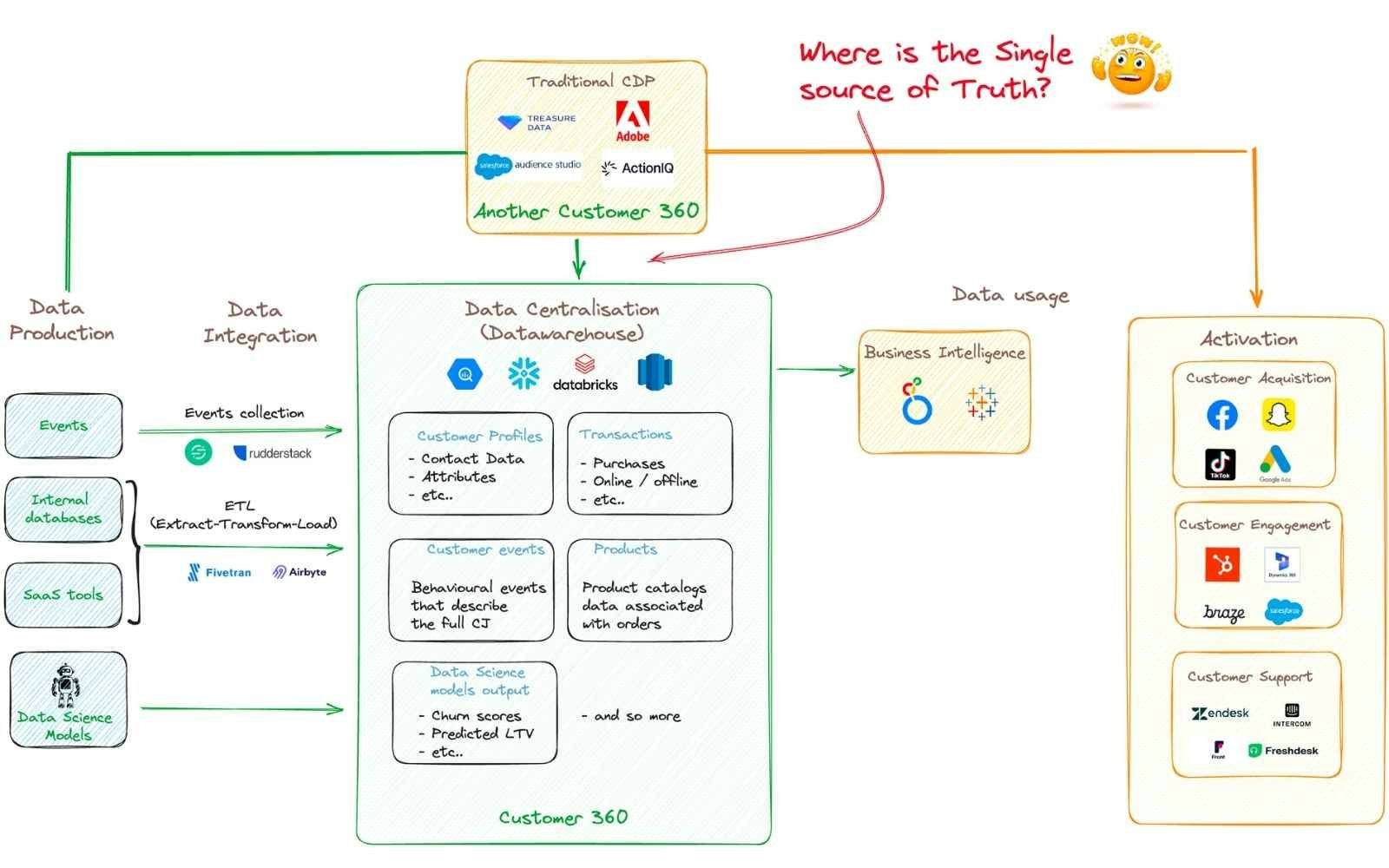
Traditional CDPs duplicate data, negating the concept of "Single Source of Truth"
CDP market size and growth in 2026
Global revenue
Recent publications put the global CDP market at several billion US dollars, but their estimates differ substantially. The table below keeps each estimate alongside its own forecast.
Research publisher | Estimated market size, 2026 | Forecast market size, 2031 | Reported CAGR, 2026–2031 |
|---|---|---|---|
MarketsandMarkets, August 2026 publication | USD 7.34 billion | USD 14.04 billion | 13.8% |
Mordor Intelligence, public market overview consulted September 2026 | USD 4.58 billion | USD 13.14 billion | 23.47% |
Sources: MarketsandMarkets and Mordor Intelligence. These figures are publisher estimates and forecasts; they are not audited totals of all CDP purchases.
Do not average the estimates or combine their growth rates. Market definitions can include different combinations of software, implementation services, marketing cloud capabilities and warehouse-based platforms. Differences in methodology also affect the results. A lower estimate is not automatically an underestimate.
Market growth
Both publications forecast growth through 2031, but neither supports a universal claim that the market will grow by more than 30% annually. A compound annual growth rate describes a projected change over a defined period; it does not mean that every year, region or vendor grows at that rate.
The CDP Institute’s January 2026 industry update describes modest industry growth, increasing concentration and architectural differentiation during the second half of 2025. This provides another perspective: industry consolidation can coexist with growing demand for customer data capabilities.
For buyers, the useful question is how market development affects product continuity, integration support and the capabilities available to their teams. A forecast alone cannot establish the return on a particular CDP investment.
Key drivers of CDP market growth
Several business needs explain demand for customer data platforms:
First-party data management: bringing together information a business obtains through its own customer relationships and interactions.
Connected cloud systems: linking customer data held across a CRM, commerce platform, data warehouse and campaign tools.
Customer analytics: using reliable profiles to understand behaviour, build a segment and assess engagement over time.
Personalisation: using relevant customer attributes and recent events to adapt messages, recommendations and experiences.
Multichannel activation: making selected data available to the email, advertising and service systems that execute an action.
Third-party cookie restrictions remain relevant, but a universal end to cookies in Chrome should not be presented as an established fact. In its April 2025 announcement, Google retained the existing approach to user choice rather than introducing a separate prompt. The business case for governed first-party data does not depend on one browser deadline.
Market distribution
By deployment and component
Market reports also distinguish cloud-based and on-premises CDPs, and separate platform revenue from services. Grand View Research uses these dimensions in its market analysis. They help explain why two businesses buying similar customer data capabilities may face different delivery models and costs.
Cloud-based CDPs operate in cloud environments; on-premises CDPs run within infrastructure managed for the organisation. This distinction is separate from packaged versus composable architecture. Packaged CDPs and warehouse-based CDPs can both use cloud infrastructure.
The services component covers work around the platform, such as data integration, implementation and ongoing support. When reviewing market growth, check whether a forecast includes these services. When budgeting for your own CDP, check which team or partner will perform them.
By region
Mordor Intelligence identifies North America as the largest regional market and Asia Pacific as the fastest-growing in its forecast. Its overview attributes 47.32% of global revenue to North America in 2025. This is that publisher’s estimate for that year, not a universal regional split.
Regional revenue, the location of CDP vendors and customer adoption rates measure different things. A provider headquartered in North America may serve customers in Europe and Asia Pacific. Its headquarters cannot be used to infer where its revenue is generated.
For a UK or European business, regional considerations also include hosting options, implementation partners and support hours. Teams should check where customer data is processed and how the platform fits their governance requirements, rather than selecting a CDP from regional market share alone.
By industry
Retail, financial services and travel illustrate different uses of the same underlying customer data capabilities. The following examples describe possible workflows, rather than a ranking of adoption by industry.
Industry | Customer data to connect | Example use case |
|---|---|---|
Online purchases, loyalty records and store transactions | Build a repeat-purchase audience and exclude customers who have already bought from an acquisition campaign. | |
Financial services | Account relationships, service interactions and communication preferences | Coordinate relevant customer communications while applying eligibility and access rules. |
Travel | Booking history, loyalty membership and recent interactions | Adapt pre-departure messages and stop abandoned-booking reminders once a reservation is complete. |
In each case, unified profiles help teams understand the customer relationship. The result still depends on reliable data, appropriate permissions and an integration with the channel that delivers the experience. A CDP can support governance processes; purchasing one does not, by itself, establish compliance.

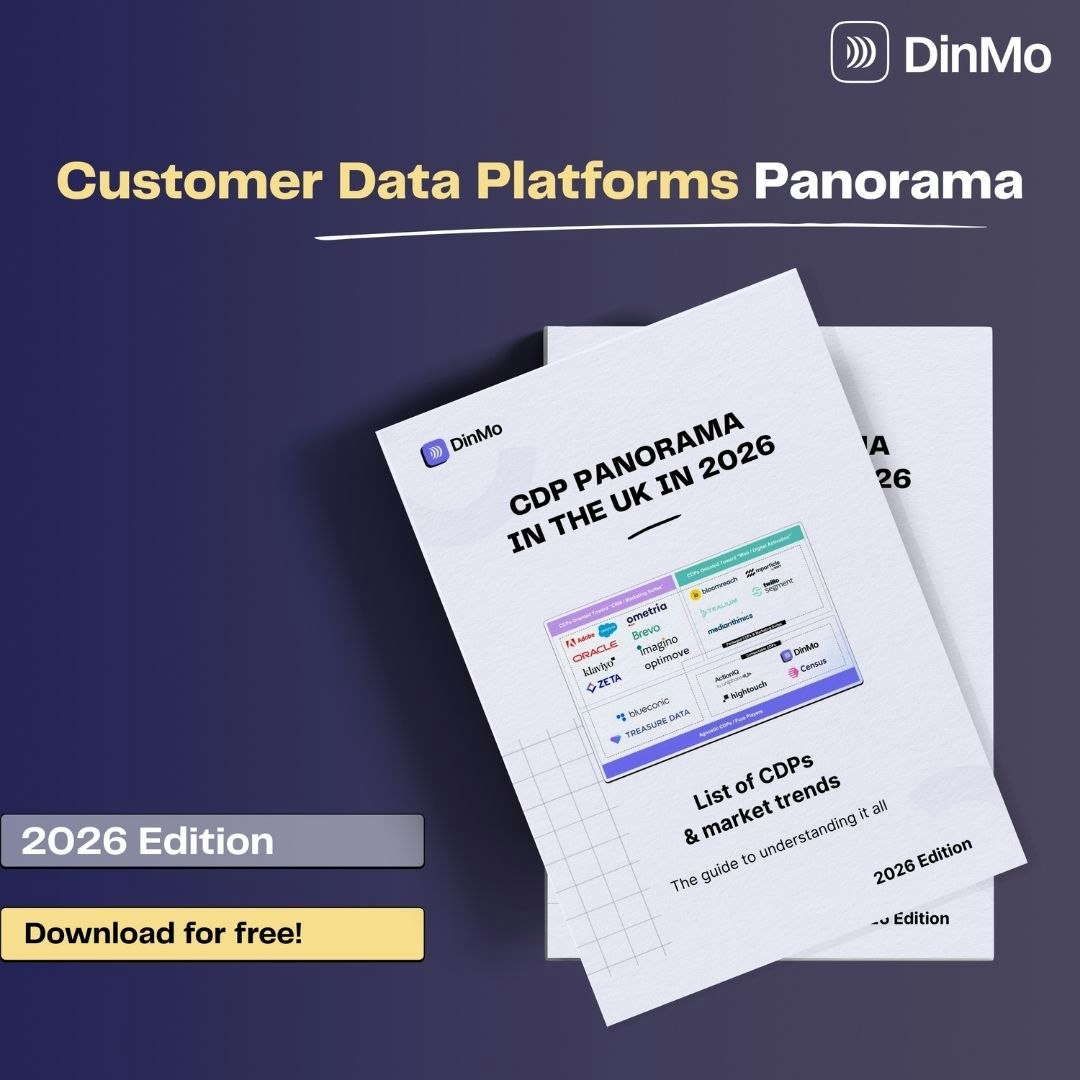
Download our white paper on the CDP market
Key market players and trends
Leading CDP providers by category
The CDP market brings together specialist customer data platforms, marketing suites and infrastructure providers. A useful distinction is between what a platform does and where customer data is managed.
Functionally, a data-focused CDP collects and unifies records; an analytics-focused platform adds customer analysis and segmentation; campaign capabilities support orchestration; delivery capabilities execute messages. A single product may cover several of these areas, while another relies on integrations with specialist tools.
Architecturally, the following categories provide a starting point for understanding the market. They are not a vendor ranking or a claim that every product in a category has identical features.
CDP approach | How it handles customer data | Examples and context |
|---|---|---|
Packaged customer data platform | Combines collection, profile management and connected activation capabilities within a vendor’s product environment. | Twilio Segment; Treasure AI, formerly Treasure Data. Check the modules included in each offer. |
Composable CDP | Builds on customer data in an existing warehouse and connects the required capabilities. | DinMo and Hightouch. Evaluate identity, audience management and destination support for the proposed configuration. |
Marketing suite CDP | Connects unified profiles to a wider ecosystem of marketing, analytics and customer experience applications. | Adobe Real-Time CDP and Salesforce Data 360. Check integration with both existing suite products and external systems. |
Hybrid approach | Combines managed profile services with warehouse-based data access or activation. | Assess the architecture of the specific deployment: this can overlap with other categories. |
An activation component is not necessarily a complete CDP. For example, Fivetran announced its acquisition agreement for Census in May 2025. Historical vendor lists should account for such changes rather than treating names and ownership as permanent.
Enterprise CDPs may need to coordinate customer profiles across multiple business units, channels and access policies. CDPs for smaller organisations may have a narrower starting point, such as connecting purchase data to an email platform. In either case, the appropriate CDP is the one that supports the required workflow at a sustainable operating cost.
Market trends
The boundary between a CDP and a broader customer engagement platform is changing. Gartner’s August 2026 market overview distinguishes stand-alone, composable, platform and embedded approaches. Its public summary emphasises architecture as a buying decision. This does not mean that every business should move to the same model: the relevant question is how customer data management connects to the tools the organisation already uses.
An embedded CDP provides customer data capabilities within another application or platform. SAS describes this approach in the context of its customer engagement offering. Buyers should establish whether unified profiles and audiences remain usable beyond that environment, including in external email, CRM and analytics tools.
Unified customer profiles remain the foundation. Marketing teams need to understand which source supplied an attribute, when it changed and how conflicting information is resolved. Profile management therefore extends beyond combining rows: it includes identity rules, data quality and governance.
Real-time capabilities need a precise definition. CDPs may offer real-time event collection while refreshing an audience less frequently. Ask how long it takes for a customer event to update a profile, change segment membership and reach an activation channel. Those are separate steps.
For example, stopping an email reminder after a purchase may require a rapid update. A weekly customer retention campaign can often use a scheduled refresh. Specify the required response time for each use case before paying for more complex infrastructure.
Marketing and data teams need a shared operating model. Self-service audience management gives marketing teams more control, but data teams still need to maintain definitions, integration reliability and access permissions. Both teams should be able to explain why a customer entered an audience and which data was sent to the destination.
Composable approaches build on existing investment. When a business already has governed customer data in a warehouse, a composable CDP can connect that foundation to marketing workflows. Where data is fragmented or poorly maintained, the underlying preparation work still needs to happen.
CDP market outlook and evolution
Enterprise and B2B CDPs: beyond individual customer profiles
Enterprise CDPs may need to connect people with accounts, subscriptions and buying groups. In B2B marketing, several contacts can influence one purchase, so an individual customer profile is only part of the picture. CDPs should preserve those relationships rather than merging every contact into a single account identity.
Adobe positions Real-Time CDP for both B2C and B2B use cases. Salesforce Data 360 connects customer data across its wider application environment. These examples illustrate why enterprise buyers should inspect the supported data model, not assume that all CDPs represent customers in the same way.
Consider an account-based campaign. Marketing needs to identify engaged contacts, sales needs the account context from the CRM, and support may need to flag an unresolved issue before an offer is sent. An enterprise CDP can support this workflow when account relationships, customer engagement data and activation rules are available together. The proof should use your account structure and channels, including the real-time updates that matter to that use case.
AI-driven customer analytics
AI-driven CDPs can extend customer analytics through predictive scores, audience suggestions and recommendations. Their usefulness depends on the data behind them. An inaccurate identity match or outdated profile can undermine an otherwise sophisticated model.
Agentic CDPs extend this scope by connecting data analysis with the preparation of audiences and actions. Agents can then use the results to inform subsequent decisions. Available capabilities and levels of autonomy need to be assessed for each platform.
Teams should connect an AI capability to a specific decision: which customers need attention, which audience should receive an offer, or which action should be withheld. Evaluate the resulting customer experience and campaign performance, including a suitable comparison group where feasible. A prediction score alone does not demonstrate additional business value.
From customer data to marketing action with DinMo
DinMo helps connect customer data in the warehouse to audience creation and activation. Using no-code audience tools, marketing teams can define audiences from available customer attributes and send the relevant data to connected business tools, while data teams maintain the underlying data foundation.
Consider a retailer building a lapsed-customer segment. The team can use purchase history to identify customers who have not ordered within a chosen period, apply communication eligibility rules and activate the audience in a campaign tool. When a customer buys again, the refresh process should remove that customer from the segment.
This illustrates the practical role of a CDP: turning unified customer information into an action that can be executed and measured. The same project should specify data freshness, destination support and responsibility for handling failed updates.
What market changes mean for your project
Before committing to a platform, turn the market overview into a short set of requirements:
Which customer data sources must the CDP connect, including the CRM and warehouse?
How will it resolve identity and maintain unified profiles across those sources?
Which audiences and channels must marketing teams activate, and how quickly?
Which analytics, governance and support capabilities are included in the proposed package?
How will the organisation measure outcomes and the full operating cost?
These questions can inform a CDP request for proposal without turning market share or a vendor category into the deciding factor.
Key capabilities of modern customer data platforms
The expanding CDP market can make feature lists difficult to compare. Gartner’s public category definition includes collection, integration, analytics, profile management, segmentation and decisioning. The table translates those capability areas into practical checks for a marketing and data team; it is not a certification checklist.
Capability | Useful evidence from a CDP demonstration |
|---|---|
Data integration | Connect a real source, map customer attributes and show how the platform reports missing or rejected data. |
Identity and profile management | Reconcile two records belonging to one customer, then show how an incorrect identity match can be investigated. |
Customer analytics | Inspect the data behind a customer metric and explain whether analytics run in the CDP or a connected reporting platform. |
Audience segmentation | Build a rule-based segment, preview the customer profiles included and identify why a specific customer qualifies. |
Real-time activation | Trace a customer event through profile updates, segment membership and delivery to the selected channel. |
Governance and support | Demonstrate access restrictions, change history and the support process when an integration fails. |
An integration count is not enough. A connector may support adding a customer to an audience without supporting every profile attribute, deletion operation or response from the destination. Ask what data moves, in which direction and at what frequency. Marketing teams need to know whether the integration supports their actual customer engagement workflow.
For example, a service event recorded in a CRM may need to suppress a promotional email. That requires the CDP to receive the event, associate it with the correct customer identity and update the relevant segment. The email platform must then use the revised audience before sending. A failure at any stage can produce the wrong experience even when each platform is functioning independently.
CDP costs: the business case for customer data platforms
CDP market growth does not establish whether your organisation should invest. The business case combines platform costs with data preparation, integration and the customer outcomes the project can realistically influence.
Key cost components of enterprise CDPs
Ask each provider to price the same workload: customer profiles, events, sources, activation channels and required refresh frequency. Identify which features are included and which require an additional module. For example, Hightouch’s public pricing distinguishes a full composable CDP from individually selected capabilities and describes usage-based billing.
Cost area | What to establish |
|---|---|
CDP platform | Included profile management, analytics, audience tools, identity resolution and support. |
Data infrastructure | Storage, processing and warehouse workloads generated by customer data updates and segmentation. |
Integration | Initial connections, ongoing maintenance and ownership of failed synchronisations. |
Marketing execution | Costs of the email, advertising or customer engagement tools receiving CDP audiences. |
Operating team | Time spent maintaining data quality, governance, customer definitions and campaign measurement. |
Keep platform and channel costs separate. A CDP may prepare an audience for an email campaign while another platform sends the messages. Existing CRM or marketing licences do not necessarily include the additional CDP capabilities you need. Likewise, a composable approach can reuse a warehouse while increasing its processing workload.
How to measure the value of CDPs
Choose one customer use case and establish a baseline before expanding the deployment. Useful measures include the time needed to prepare an audience, the share of usable customer profiles, failed activation updates and the business outcome of the campaign.
For a retention programme, compare customer behaviour with an appropriate control group rather than attributing every subsequent purchase to the CDP. Evaluate contribution margin as well as revenue, and include the cost of communication and incentives. Faster segmentation is operational progress; additional profitable customer activity is a different result. Track both so the marketing and data teams share a clear definition of success.
Frequently asked questions about the CDP market
What are the best customer data platforms for marketing teams?
What are the best customer data platforms for marketing teams?
There is no universal best CDP. Adobe Real-Time CDP, Salesforce Data 360, Twilio Segment and composable providers such as DinMo represent different starting points. Compare customer data integration, profile management, activation channels and the support available for your use cases. A review rating or market presence does not establish which platform fits your architecture.
Do I need a CDP if I already have a CRM?
Do I need a CDP if I already have a CRM?
Only if there is a customer data need that the CRM and existing integrations do not adequately serve. A CDP can connect CRM records with transaction and behavioural data for segmentation across channels. If customer profiles and marketing workflows are already reliable, adding another platform may introduce cost without solving a meaningful problem.
Is a CDP worth the investment for a smaller business?
Is a CDP worth the investment for a smaller business?
A CDP can be relevant when fragmented customer data prevents a valuable marketing action. Start with a specific use case, the data required and the expected operating effort. A business that only needs to connect one source to an email tool may need a simpler integration rather than a complete customer data platform.
Does a CDP replace a data warehouse?
Does a CDP replace a data warehouse?
Not necessarily. A warehouse supports broader data storage and analytics; a CDP makes customer data usable for profile management, segmentation and activation. Composable CDPs build on the warehouse, while packaged CDPs typically manage their own customer data environment. Check how each approach maintains consistent customer definitions across marketing and analytics.
Does every CDP use case require real-time data?
Does every CDP use case require real-time data?
No. A customer interaction during a website session may need a rapid response, while a weekly audience can use scheduled processing. Define the maximum acceptable time from a customer event to the resulting action. Then verify that the full chain, including the destination platform, supports it.
Conclusion
The Customer Data Platform market continues to develop around a practical need: making customer data usable across business systems. Read estimates with their dates and scope, distinguish architecture from functionality, and test claims about real-time activation against the complete workflow.
For your business, the value of a CDP rests on reliable customer profiles, useful segmentation and coordinated engagement. Start with the customer experience you want to improve, then establish which data and capabilities your teams need to deliver it. To explore that workflow with DinMo, discuss your customer data project with the team.